
Culture by Design
All the world’s gold currently above ground would, if combined, fill approximately two Olympic sized swimming pools. While global gold production has remained fairly constant in recent years at 2,500 tonnes per annum, no single country accounts for more than 14% of world production, China currently being the world’s highest producer.Yet the cost of gold production has increased significantly; so-called ‘easily accessible’ mineral sources have already been prospected and mined, so gold mining companies have to discover and mine often low-grade ore bodies in geographically- and/or politically-challenged environments. Gold production has thus become an increasingly expensive yet low margin business. But of course any mining company must invest in the replenishment of its reserves either through funded exploration or acquisition.
In 2010 our client acquired two African mines for a little over $7 billion; an expansion project to develop the larger of the two held the promise of increasing production at that mine from 56,000 ounces per year to 1.5 million. The market price for gold per ounce had plummeted from its high in September 2011 of $1,921 to around just $1,200 at the end of 2012 when Omada first started working with the management team at the smaller of the two acquired mines. Sitting in the Bibiani gold belt, around 100 kilometers southwest of Kumasi, Ghana’s second largest city, and operating both open pit and underground mines across 11 deposits, the smaller mine was a steady producer although, as currently conceived, one with limited mine life.
The issues for the business were clear from the outset and precisely articulated by the newly appointed General Manager, a highly experienced operator and business leader coming out of a senior expatriate role in South America. The business was very siloed with poor communication between departments; previous general management had deployed a highly autocratic style quashing the development of senior management thinking and consequently ensuring that what should have been the pipeline of tomorrow’s leaders were working at least one if not two levels below their pay grade. That next generation lacked both guidance and empowerment to consider and determine the future for the mine, its community and the region as a whole. Desperately in need of having their sights raised, senior management had become distracted by innumerable incomplete projects and non-core activities while expensive contractors delivered the core mining processes.
The new General Manager’s considered and firm yet inclusive style was playing out well with senior management who soon found themselves speaking up and contributing to discussions and decisions making. He had watched the operation carefully over his first few weeks and wanted to bring his team together to help them get to know him and each other more fully, to better understand how they might work together to break down the silos and to lay out a vision for the business. That’s when he contacted Omada having already seen our work with his boss’s team, the Africa Regional Leadership Team. At the resulting workshop the agenda enabled his team to focus on all those challenges; the vision developed suddenly scoped out a role for the mine as a major contributor to the global portfolio and a chance to come out from the shadows of the larger expansion project which necessarily attracted so much of the Africa Region’s leadership bandwidth and attention.
A key challenge was getting the General Manager’s immediate team members to prioritise and focus the mine operation on just a few Core Goals in such a way that the rest of the organisation could get behind the vision. Start by asserting a Core Goal of Safety, we said; if you get that right, everything else will follow. Research and our own experience across mining and heavy industry environments bears out the wisdom of this advice; the creation of a robust Safety culture ‘infects’ all the other disciplines, be they procurement, budgetary management, those relating to performance management, training or any other facet of the business. We also identified two other Core Goals - Cost Effectiveness and Collaboration. It’s a well-established psychological principle that the brain finds it relatively easy to communicate and grasp sets of three.
With those three Core Goals set, our task was then simply defined - engage the rest of the management population, some 40 or so staff, with those goals. We sought to do that through the design and implementation of a Culture Change Programme, one that would empower staff to challenge and change every part of the business in line with those Core Goals. A critical targeted outcome of the Programme was that the current siloed activity would rapidly become a thing of the past; everyone would need to work together with focus and enthusiasm, to collaborate across departments and with the local community and government if the vision was to be realised.
Nana, our West African expert, was the obvious choice to lead the Programme: a Ghanaian national, UK based Omada team member with many family members and friends living in Ghana, she has wide ranging business experience and the kind of cultural awareness that was essential to nuance the delivery of this particular project. The top 40 included expats and nationals as well as individuals from neighbouring countries and people who had been born in England or Australia but had lived their lives in West Africa - a breadth of perspectives that needed careful handling.
Nana ran several two-day long workshops for cross-functional groups of 10 managers or so, allowing them to properly interact with colleagues with whom they had rarely communicated effectively. Nana got them sharing their histories and looking forward to a collaborative future. They worked on the Core Goals, and what each of them could do to advance the cause, making personal and business development commitments and focusing on ways to ensure they honoured those in the months ahead. Within a few short weeks, inspired by the change in culture and leadership, management team members brought forward a proposal to end all contractor mining services in the open pit and instead move to an Owner Operated business model. This was a major shift but one that once implemented would see a massive 38% reduction in costs over contractor rates. The mine’s safety record also improved significantly with the Exploration function recently celebrating a Lost Time Injury free period of four years.
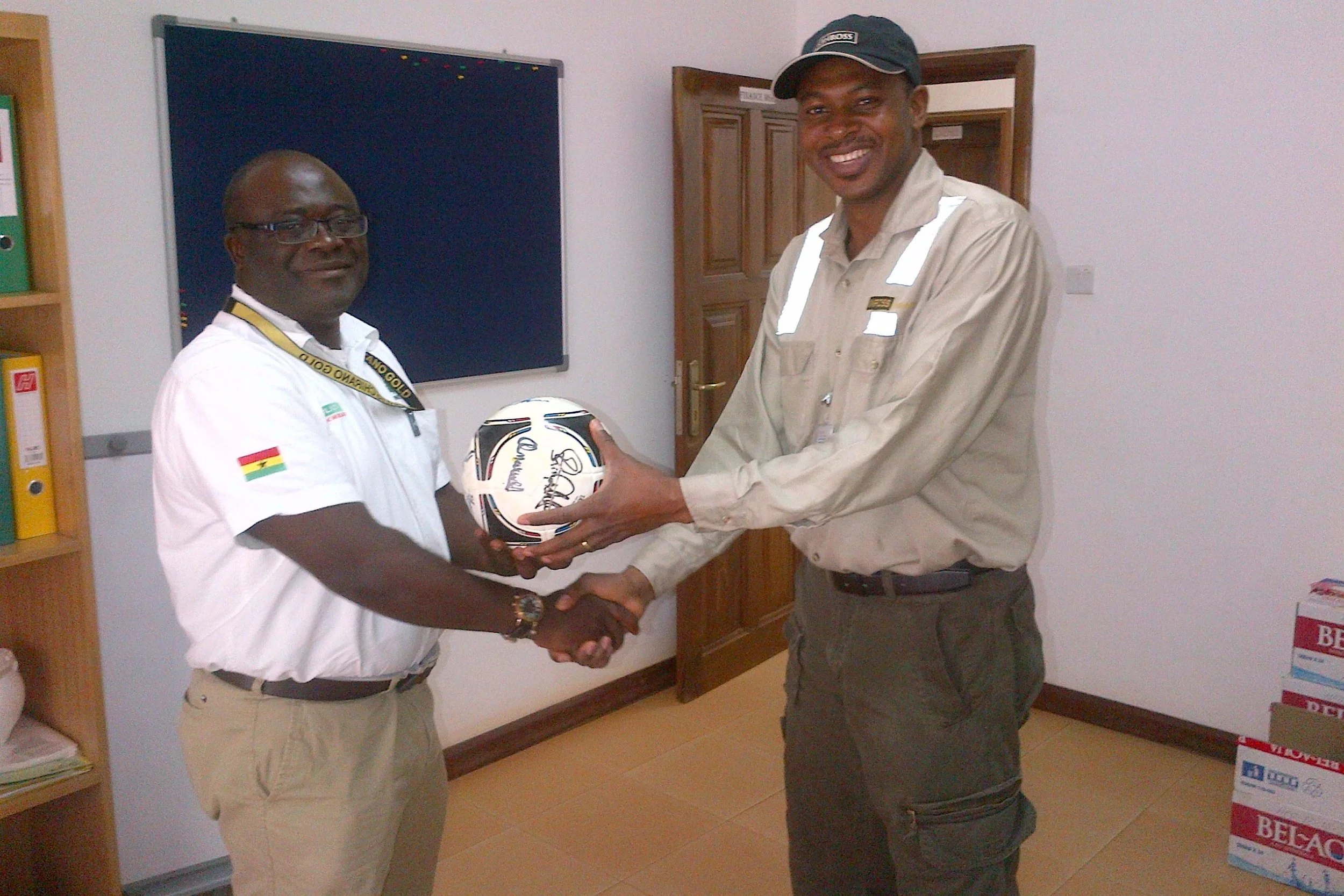
Football is big in many countries but huge in Ghana. Tapping into that cultural understanding on completion of the workshops Nana gave the management team a football, to be passed from one team member to another each week. The current holder of the ball was to identify a colleague who had done something noteworthy in pursuit of the Core Goals and pass the ball to them with an email to the entire management team outlining the reasons for their selection that week - sharing the successes. Here’s an extract from one email:
“It is my pleasure to pass the Ball to the Playing Coach of our Procurement team. With Catherine in the lead, the Procurement Team has been successfully delivering value to all departments, providing much needed advice and guidance and saving money; their excellent, hard work is appreciated and valued by all of us. Looking ahead to the coming spring and new challenges it will bring with the Underground transition, procurement reliability and sustainability will be a major theme. Just as in football, they cannot do it alone. A team of stable and reliable players is so much better than a one season star because talent wins games, but teamwork wins championships. Catherine, we will support you and your team during these busy times. Congratulations! Keep up the good work!”